


- Model
- TECHbeam-Soft®
- Type
- Beam dyeing
- Fabric form
- Open width · long runs
- Beam diameter
- Ø90 – Ø1100 mm
The fabric stays still, the liquor does the work.
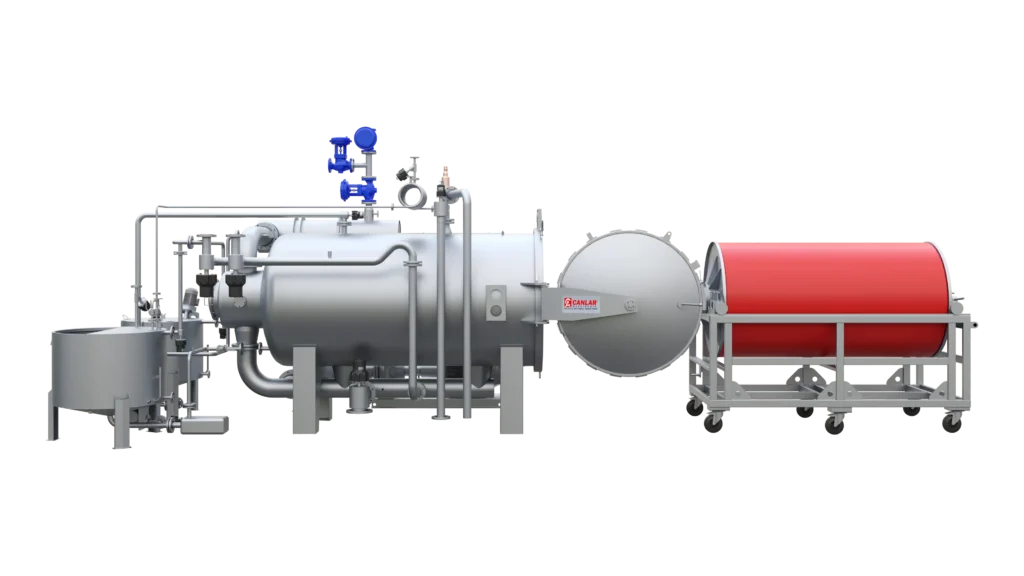
TECHbeam-Soft® dyes without circulating the fabric. Long runs of open-width fabric are wound onto a perforated beam and the liquor is passed through that winding. Because the fabric does not move, crease marks, friction and tension-related faults are ruled out from the start.


On a wound beam the real risk is not on the surface, but in the color difference between the layers.
-
Inner and outer layer
If the liquor loses speed as it travels through the layers, the inner layer is dyed differently from the outer one.
-
Evenness of the winding
Fabric wound loosely or unevenly offers a different resistance to the flow at every point.
-
Rising resistance
As the number of layers grows, so does the resistance the flow meets; working at a fixed pressure is not enough.
Six points that make the layers equal
In beam dyeing, quality depends not on how the fabric moves but on how the liquor passes through the winding. The design of TECHbeam-Soft® makes that passage measurable.

-
01
Differential-pressure-controlled circulation
The differential pressure values of the inside-to-outside circulation (optionally outside to inside) are set individually from the control computer. The function is provided by a differential pressure transmitter and a pump inverter.
Your gain. The liquor passes through every layer with the same force, and the unlevelness problem disappears.
-
02
Beam diameter and perforation
The beam diameter and the perforation pattern were specially designed to increase the effectiveness of dyeing. Different diameter options between Ø90 and Ø1100 mm are offered according to the fabric type.
Your gain. Every fabric is wound onto a beam matched to its own flow resistance, and the winding thickness stays under control.
-
03
Blanking pieces and short beams
With additional blanking pieces, fabric of a narrower width can be wound onto the beam. For very narrow widths there are short beams that can be placed side by side inside the machine.
Your gain. Narrow-width work is carried out on the same machine, and the liquor does not escape through the uncovered beam surface.
-
04
High-pressure dosing pump
Dosing from the dye tank into the machine can be carried out even while the vessel is under 2.0 bar air pad pressure.
Your gain. The pressure is not lowered in order to add chemicals; dosing takes place at the moment and gradient set in the recipe.
-
05
Pressurization by injection pump
Pressurization is carried out by an injection pump and an air pad; the cooling coil system supplies water to the injection pump. Draining is accelerated with a 0.6 bar air pad.
Your gain. Filling and draining times are shortened and batch changeover becomes faster.
-
06
Recipe-based automation and measurement
Dyeing is run on a recipe basis from an industrial computer. There is analog level measurement in the vessel, precise level control in the dye tank by pressure transmitter, and an inverter and differential pressure transmitter pair on pump performance.
Your gain. Every batch runs with the same pressure and level profile, and the result becomes independent of the shift.
Three elements that determine the winding and the flow
Beam and perforation
The beam diameter and the perforation pattern were designed so that the liquor reaches every layer of the winding equally. Diameter options between Ø90 and Ø1100 mm are offered according to the fabric type, and different lengths are produced on request.
Blanking pieces are used for narrow-width fabrics, and short beams placed side by side for very narrow widths.

Beam trolley and rail system
The beam is brought alongside and driven into the dyeing machine on a mobile transport trolley. The coupling and rail systems on the beam make the fabric beam easy to load and remove.
The trolley was designed to be usable on machines of two different diameters, so no separate investment is needed for a second machine.

Dye tank and injection tank
During dosing, the solution is dosed and diluted from the dye tank into the injection tank. The stirring mixer keeps the solution homogeneous, and the dye tank level is monitored precisely by a pressure transmitter.
The solution entering the vessel is therefore at the same concentration every time.

This investment is approved by more than one person
The same machine tells each person at the table something different. We answer each of their questions separately.
-
Business owner
Work that cannot be done in rope form
Long runs of open-width fabric, nonwoven surfaces and qualities that cannot be run in rope form because of the risk of creasing are dyed on this machine. Work you currently turn away is added to your portfolio.
- Long runs
- Nonwoven and delicate qualities
- Open width
-
Dyehouse manager
Equal color between the layers
The circulation direction and the differential pressure values are set individually from the computer. Even if the number of layers and the tightness of the winding change, the force with which the liquor passes stays under control.
- Unlevelness control
- Adjustable differential pressure
- Recipe-based dyeing
-
Purchasing
Supply without risk
Manufacture to pressure vessel standards, independent inspection, testing before dispatch and a single point of contact. There is no waiting in an import queue for spare parts.
- Certified manufacture
- Single point of responsibility
- Fast parts
It arrives on site ready to run
You are not testing a prototype. The machine is run before it leaves our factory.
-
01
Design and validation
The vessel diameter, the beam diameter and the number of beams are determined according to your fabric type, your width and run length and your plant layout, and design validation is carried out at our R&D center.
-
02
Manufacturing
Vessel, beam, piping and control panel are produced in our own facility. Every part is finished at its own station.
-
03
Factory testing
The machine is fully assembled and passes hydrostatic pressure and function testing; the panel is verified by simulation.
-
04
Commissioning
Our field team carries out the installation and trains the operators. Remote support and periodic maintenance follow.
Sustainability is our priority
The greatest environmental advantage of beam dyeing is not hidden but structural: because the fabric does not move, there is no need for enough water to carry it. The liquor circulates only as much as it takes to pass through the winding.
A system that does not carry the fabric does not heat enough water to carry it. In beam dyeing the source of the saving is the process itself.
-
Water to pass through, not to carry
Because the fabric stays wound on the beam, the liquor is circulated only as much as it takes to pass through the winding.
For your plantThe water heated, the chemicals consumed and the effluent sent to treatment fall together.
For the planetWater that is not used is water that never goes to treatment; it stays in the basin.
-
Measured pressure, repeated result
Circulation is managed by a differential pressure transmitter and an inverter, so every batch runs with the same profile.
For your plantOff-shade results and the frequency of reprocessing are reduced.
For the planetA second dyeing that is never carried out is water, chemicals and energy never spent.
-
Proportional heating and cooling
Heating and cooling are managed proportionally, and the combined cooling and rinsing system merges two operations into a single step.
For your plantSteam and cooling water costs fall and the process time shortens.
For the planetEvery cubic meter of steam burned is a direct carbon emission; a shorter process shortens the emission with it.
-
A process that does not touch the fabric
Because the fabric does not move, no scrap arises from friction, tension or creasing.
For your plantSecond-quality output and waste shrink as cost items.
For the planetEvery meter of fabric that is not scrapped is fiber, water and energy not spent.
The common denominator of the work at our R&D center is this: achieving the same color with fewer resources and fewer attempts. We assess every new solution we develop against that measure.
Technical data and dimensions
| Item | Standard beam machine | TECHbeam-Soft® |
|---|---|---|
| Circulation direction | One way | Inside to outside · optionally outside to inside |
| Circulation control | Fixed pressure | Differential pressure transmitter + pump inverter |
| Dosing | By lowering the pressure | By high-pressure dosing pump, under 2.0 bar |
| Beam options | Single diameter | Ø90 – Ø1100 mm · different lengths |
| Narrow-width fabric | Limited | Blanking pieces and short beams side by side |
| Control | Operator discretion | Recipe based, by industrial PC |
| Fabric form | Open width · long runs |
|---|---|
| Fabric type | Knitted, woven and nonwoven; cotton, cotton-synthetic, polyester-nylon and blends |
| Processes | Bleaching, dyeing, washing |
| Vessel diameter | Up to Ø1800 mm |
| Dyeing beams | Ø90 – Ø1100 mm |
| Number of beams | One or several beams |
| Circulation | Differential-pressure-controlled inside to outside · optionally outside to inside |
| Pump control | Inverter and differential pressure transmitter pair |
| Pressurization | Injection pump and air pad |
| Dosing | High-pressure dosing pump · dosing under 2.0 bar |
| Dye tank | Precise level control by pressure transmitter · stirring mixer |
| Vessel level | Analog level measurement |
| Heating and cooling | Proportional · combined cooling rinse (CCR) |
| Draining | Fast draining with a 0.6 bar air pad |
| Rinsing | Overflow rinsing · cooling rinse |
| Door | Kalibo door in accordance with safety standards |
| Beam handling | Mobile beam trolley · rail system |
| Control | Recipe-based dyeing by industrial PC |
| Beam width (Lbeam) | 3,800 mm |
|---|---|
| Fabric width (Lfabric) | 3,400 mm |
| Machine length (L) | 4,300 – 5,400 mm |
| Machine width (W) | 1,300 – 2,500 mm |
| Machine height (H) | 1,500 – 3,100 mm |
| Number of sizes | 14 models, from 210 up to 1500 |
The dimensions belong to the Ø220 mm beam series and are approximate. Dimensions change with different beam diameters. The manufacturer reserves the right to change manufacturing dimensions without notice; exact dimensions for plant layout are shared at the quotation stage.
- TÜV approved
- AD 2000 Merkblatt
- EN 13445
- ASME
- CE · 2014/68/EU
- ISO 9001
- ISO 14001
- Ministry-approved R&D and Design Center
The most asked questions about beam dyeing
01 When is beam dyeing preferred?
In any work where circulating the fabric in rope form is inadvisable. Long runs of open-width fabric, nonwoven surfaces, wovens with a high risk of crease marks and qualities where dimensional stability is critical are dyed by this method. Because the fabric stays wound on the beam, no friction, tension or creasing occurs.
02 How is the color difference between the layers prevented?
This is the real risk in beam dyeing. The differential pressure values of the inside-to-outside circulation are set individually from the control computer, and the function is provided by a differential pressure transmitter and a pump inverter. Even if the winding thickness and the number of layers change, the force with which the liquor passes can be adjusted, so the unlevelness problem disappears. Outside-to-inside circulation is also offered as an option.
03 Can I dye narrow-width fabric?
Yes. Thanks to additional blanking pieces, fabric of a narrower width can be wound onto the beam. For very narrow widths, short beams that can be placed side by side inside the machine are used, so machine capacity is not left idle.
04 Can more than one beam be used in a single machine?
Yes, the machine can be run with one and/or several dyeing beams. The beam diameter is selected between Ø90 and Ø1100 mm according to the fabric type, and different lengths are produced on request.
05 How are the beams loaded and unloaded?
The beam is brought alongside and driven into the machine on a mobile transport trolley. The coupling and rail systems on the beam make loading and removal easier. Because the trolley was designed to be usable on machines of two different diameters, a separate trolley is not needed for a second machine.
06 How do spare parts, training and the warranty work?
Because production from the body to the automation panel is carried out in our own facility, parts come from our own stock. During commissioning our field team provides operator training on site. The warranty period and scope are set by contract; after the warranty, remote connection, periodic maintenance and field service continue.
Tell us your fabric width and your run length,
and we will choose the right beam diameter together.
Share your fabric type, width, run length and typical batch size, and we will come back to you with a suitable vessel diameter, beam diameter and number of beams.
Our Other Dyeing Solutions
 TOWEL DYEING