


- Model
- DRYTEX Crosswise®
- Type
- Cross-chamber drying
- Working width
- 1.6 – 3.4 m
- Number of chambers
- 2 – 6
Every point of the fabric dries with the same air.
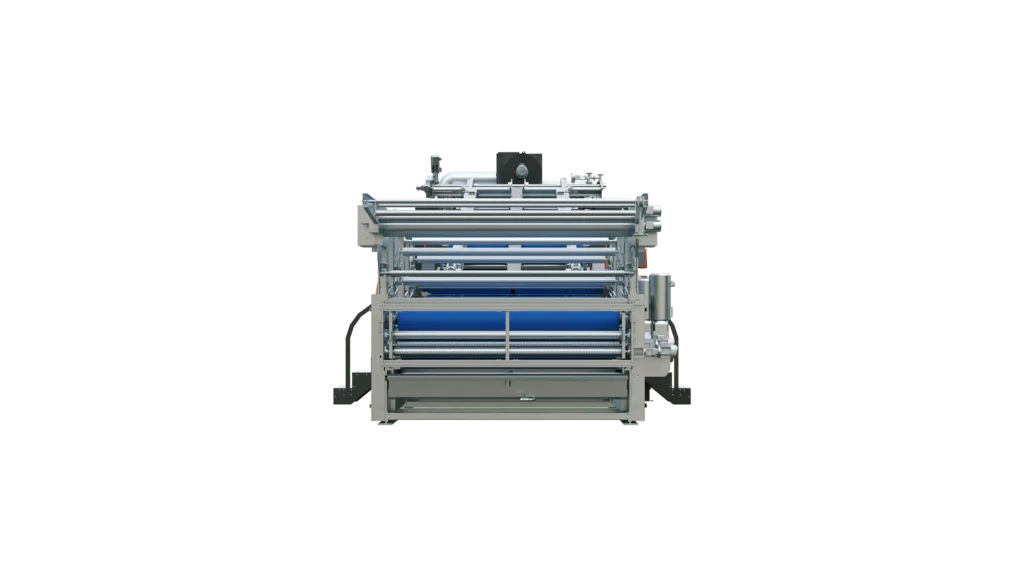
DRYTEX Crosswise® is a conveyor dryer in which the drying chambers are arranged crosswise. The cross arrangement gives the fabric a homogeneous air distribution, and the balanced circulation allows the automatic lint filter cleaning system to work at maximum performance. It is configured for open-width and tubular fabric as a single, double, three or four pass machine, with between 2 and 6 chambers.


Drying is the last step of the finishing line; its faults are also the last to be noticed.
-
Variation across the width
On fabric the air reaches in one area sooner and in another later, shrinkage and handle differ across the width.
-
Over-drying
The fuel spent evaporating water that is no longer there does not come back, and the handle of the fabric goes with it.
-
Silent capacity loss
A clogged lint filter does not lower the temperature but the air flow. The panel looks normal while the machine slows down.
Six points that determine the drying
Raising the temperature in a drying machine is easy. The hard part is delivering that temperature to every point of the fabric in the same way and keeping it there throughout the shift. The design of DRYTEX Crosswise® is built around those two problems.
-
01
Cross chamber arrangement
The drying chambers are arranged crosswise. The air is distributed to the fabric not from a single direction but in a pattern that crosses between the chambers.
Your gain. A homogeneous air distribution is achieved across the width of the fabric; this is where the machine takes its name from.
-
02
Nozzle channel structure
With its homogeneous air-blowing property, the channel offers three different nozzle configurations. The covers are easy to remove.
Your gain. A configuration suited to the fabric type is selected; maintenance and cleaning are carried out quickly and the inside of the channel stays accessible.
-
03
Automatic lint filter cleaning
Dust and lint accumulated on the filter screen are suctioned into a bag using an extraction fan and air assistance. The cleaning head moves back and forth over the screen by means of a pneumatic cylinder.
Your gain. The air flow stays constant throughout the shift. The balanced circulation is what allows this system to work at maximum performance.
-
04
Relax or equalizing drying
The line is configured either as relax drying or as equalizing drying. The fabric advance speed is adjusted between 0% and 50%.
Your gain. The relax configuration is chosen where bulk and a soft handle are wanted, the equalizing configuration where width and shrinkage control come first.
-
05
Crossover unit
The unit that optimizes the rotation values of the fabric works at the entry of the line, before drying.
Your gain. The spirality that makes side seams twist in knitted fabric is corrected before the fabric reaches the sewing room.
-
06
Configured for your plant
The working width is selected between 1.6 and 3.4 m in steps of 200 mm, the number of chambers between 2 and 6, and the number of passes between one and four. Heating is by steam, natural gas, LPG or thermic oil.
Your gain. The machine is built around your existing energy infrastructure, and to increase capacity you enlarge the number of passes rather than the floor area.
Three details that determine the result
Nozzle channel structure
With its homogeneous air-blowing property, the channel offers three different nozzle configurations. The configuration is selected according to the fabric type and the penetration required.
Thanks to its easy-to-remove covers, maintenance and cleaning are carried out quickly. A channel that can be cleaned still delivers its first-day air flow months later.

Automatic lint filter cleaning system
Dust and debris accumulated on the filter screen are suctioned into a bag using an extraction fan and air assistance. By means of a pneumatic cylinder the cleaning head moves back and forth, cleaning the system effectively.
As long as the screen stays clean, drying capacity does not fall. This is the most overlooked saving in drying.

Change of the knit structure along the line
The loop geometry is followed at four points along the line: padder entrance, over feeding, chain exit unit and relax dryer exit.
The result of drying is read in the difference between those four sections. The advance speed and the configuration are chosen to manage that difference.

This investment is approved by more than one person
The same machine tells each person at the table something different. We answer each of their questions separately.
-
Business owner
Capacity is measured at the end of the shift
Evaporation capacity starts at 80 kg/h per chamber and rises to 250 kg/h in the four-pass configuration. Because the screen stays clean, that capacity does not fall during the day; the heating source is selected according to whichever is most economical in your plant.
- Constant capacity
- Four heating options
- Modular growth
-
Finishing manager
The same result across the width
The cross chamber arrangement evens out the air distribution, while the adjustable advance speed and the crossover unit bring width, shrinkage and rotation values under control. Once the recipe is settled, it repeats.
- Homogeneous air
- 0–50% over feeding
- Rotation control
-
Maintenance manager
Maintenance goes into the schedule, not into memory
The fabric conveyor chain is lubricated automatically at the specified period and duration, and the other points are lubricated centrally. The filter screen cleans itself, and the nozzle channel is cleaned by opening a cover.
- Automatic chain lubrication
- Central lubrication
- Accessible channel
It arrives on site ready to run
You are not testing a prototype. The machine is run before it leaves our factory.
-
01
Design and validation
The number of chambers, the number of passes and the working width are determined from your fabric type, your hourly capacity, your existing energy source and the dimensions of your hall; design validation is carried out at our R&D center.
-
02
Manufacturing
Frame, chambers, air ducts, piping and control panel are produced in our own facility. Welded manufacturing is carried out within the scope of EN ISO 3834-2.
-
03
Factory testing
The machine is assembled and passes a function test with the fan group and the air distribution running; the panel is verified by simulation.
-
04
Commissioning
Our field team carries out the installation and trains the operators. Remote support and periodic maintenance follow.
Sustainability is our priority
Drying is the step where most of the energy in a finishing line is spent. Every improvement here goes straight onto the fuel bill. DRYTEX Crosswise® lowers consumption not by turning the heat down, but by not wasting it.
Saving in drying is not achieved by lowering the temperature, but by controlling where the air goes and how much of it goes there.
-
Homogeneous air ends over-drying
The cross chamber arrangement delivers the same air to every point of the fabric, so drying is set by the fabric as a whole and not by its driest area.
For your plantThe extra drying time and fuel added as a safety margin disappear.
For the planetFuel burned to evaporate water that is no longer there is a direct carbon emission.
-
A screen that does not clog, a fuel figure that does not drift
The automatic lint filter cleaning system keeps the air flow constant throughout the shift, and the nozzle channel is cleaned through removable covers.
For your plantFuel consumption per kilogram of water does not rise over time, and the cleaning stop comes out of the schedule.
For the planetDoing the same work with less fuel is the plainest definition of efficiency.
-
The energy source is chosen to suit the plant
Heating can be by steam, natural gas, LPG or thermic oil; the machine is adapted to the existing infrastructure.
For your plantYou are not obliged to build a new energy infrastructure.
For the planetUsing the source already running in the plant efficiently consumes fewer resources than building a new one.
-
The most sustainable machine is the one you do not have to replace
Welded manufacturing is carried out within the scope of EN ISO 3834-2, and because the line is built modularly, it is the configuration rather than the machine that changes when capacity needs grow.
For your plantReinvestment is deferred and the life of the line is extended.
For the planetEvery machine that is not built is steel, energy and transport not spent.
The common denominator of the work at our R&D center is this: achieving the same result with fewer resources and fewer attempts. We assess every new solution we develop against that measure.
Configurations and technical data
| Item | DRYTEX® (one side) | DRYTEX Crosswise® (cross type) |
|---|---|---|
| Chamber arrangement | One side | Crosswise |
| Air distribution | Per chamber | Crossing between chambers, homogeneous across the width |
| Automatic lint filter cleaning | System available | Maximum performance with balanced circulation |
| Total width · single pass | Working width + 2.8 m | Working width + 3.5 m |
| Total width · multi pass | Working width + 4.2 m | Working width + 4.9 m |
| Working width · speed · chambers | 1.6 – 3.4 m · 5 – 80 m/min · 2 – 6 | 1.6 – 3.4 m · 5 – 80 m/min · 2 – 6 |
| Working width | 1.6 – 3.4 m in steps of 200 mm · different values on request |
|---|---|
| Length of drying chamber | 2 m |
| Number of chambers | 2, 3, 4, 5 and 6 chambers |
| Number of passes | Single, double, three and four pass |
| Machine speed | 5 – 80 m/min · higher speeds on request |
| Fabric advance speed | 0 – 50% · adjustable over feeding |
| Fabric guidance | Open width: single track · tubular: single or multiple track |
| Relax dryer length | Chambers + approx. 5 – 8 m · according to the configuration |
| Equalizing dryer length | Chambers + approx. 18 – 19 m · according to the configuration |
| Heating system | Steam · natural gas · LPG · thermic oil |
| Air channel | Three different nozzle configurations · easy-to-remove cleaning cover |
| Filter | Automatic lint filter cleaning · extraction fan and bag dust collection |
| Lubrication | Automatic chain lubrication · central lubrication points |
| Single pass | 80 kg water/h per chamber |
|---|---|
| Double pass | 120 kg water/h per chamber |
| Three pass | 220 kg water/h per chamber |
| Four pass | 250 kg water/h per chamber |
The total evaporation capacity is the per-chamber figure multiplied by the number of chambers. Actual capacity varies with the fabric type, the inlet moisture and the required outlet moisture. The manufacturer reserves the right to change manufacturing dimensions and technical information without notice.
- CE
- EN ISO 3834-2 · TÜV SÜD approved welded manufacturing
- ISO 9001
- ISO 14001
- TSE-HYB
- Ministry-approved R&D and Design Center
The most asked questions about drying
01 What does the cross chamber arrangement do?
Thanks to the cross arrangement of the chambers, a homogeneous air distribution is achieved over the fabric. Because the air reaches the fabric at the same intensity across the width, one area does not dry before another, and the differences in shrinkage, weight and handle that follow from that do not arise. The more balanced air circulation also allows the automatic filter screen to work at maximum performance. The only trade-off the arrangement requires is approximately 70 cm more total width than the one-side configuration.
02 What happens when the filter screen clogs?
As the screen clogs the air flow falls, but because the temperature set point continues to be met, everything looks normal on the panel. The result is a silent loss of capacity: the speed is reduced for the same fabric and the fuel per kilogram of water rises. In the automatic lint filter cleaning system, the dust and debris that accumulate are suctioned into a bag using an extraction fan and air assistance, and the cleaning head sweeps the screen by moving back and forth with a pneumatic cylinder. No stop is therefore needed for cleaning.
03 How many chambers and how many passes should I choose?
Evaporation capacity is given per chamber: 80 kg water/h in the single-pass configuration, 120 in the double pass, 220 in the three pass and 250 kg water/h in the four pass. Total capacity is that figure multiplied by the number of chambers, and the machine is built with between 2 and 6 chambers. Increasing the number of passes is the way to enlarge the drying length without taking up more space on the floor. Share your fabric type, the inlet moisture and your hourly target and we will determine the right combination together.
04 What is the difference between relax drying and equalizing drying?
In relax drying the fabric is carried on the conveyor without tension; bulk and a soft handle come first, and the line is chambers + approximately 5 – 8 m long. In equalizing drying the fabric is carried by a conveyor chain at a set advance speed; width, shrinkage and the knit structure are brought under control, and the line extends to chambers + approximately 18 – 19 m. The choice is made according to what you expect from your fabric and the length of your hall.
05 Which fabrics and which widths does it run?
Single track working is possible with open-width fabric, and single or multiple track working with tubular fabric. The working width is selected between 1.6 and 3.4 m in steps of 200 mm; different widths are available on request. Because the fabric advance speed can be adjusted between 0% and 50%, your shrinkage target is given during drying. Edge starching, enzyme washing and finishing units can be added at the line entry.
06 How do spare parts, training and the warranty work?
Because production from the frame to the air ducts and from the piping to the automation panel is carried out in our own facility, parts come from our own stock; there is no waiting in an import queue. During commissioning our field team provides operator training on site. The warranty period and scope are set by contract; after the warranty, remote connection, periodic maintenance and field service continue.
Tell us your fabric and your hourly target,
and we will set the number of chambers and passes together.
Share your fabric type, weight, moisture content after squeezing, daily production target and the dimensions of your hall, and we will come back to you with a suitable configuration and heating option.
Our Other Solutions
DRYTEX Relax®
 FABRIC DYEING
TECHsmart®
 FABRIC DYEING
AIRsmart®
 TOWEL DYEING