


- Model
- AIRsmart®
- Type
- Air-flow fabric dyeing
- Fabric weight
- 120 – 500 g/m²
- Fabric width
- Up to 200 cm
It is not water that moves the fabric,
it is air.
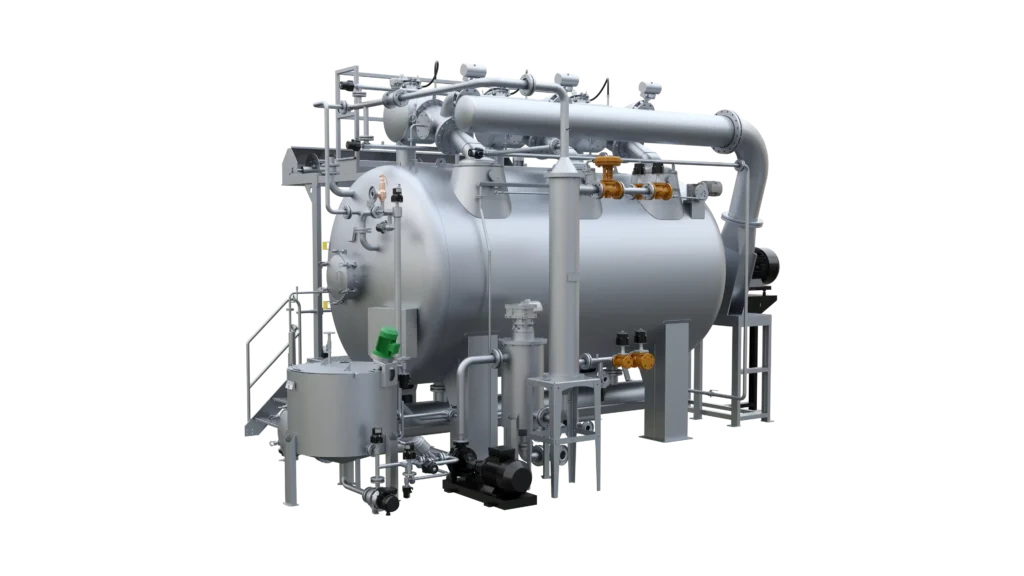
AIRsmart® does not pull the fabric through the bath. The air stream produced by a frequency-controlled fan carries the fabric, and the liquor is injected into that stream. Tension on the fabric stays at the lowest possible level, and dyeing is carried out with a liquor volume far below that of conventional machines.

What damages the fabric is not the dyeing itself, but the tension applied during it.
-
Crease marks are permanent
Fabric that advances by being pulled through water folds on itself, and the crease mark that forms cannot be corrected after dyeing.
-
The surface suffers
Friction spoils the handle on tightly constructed and delicate fabrics.
-
Dimensions are lost
Knitted fabric that advances under tension stretches, and width and length values no longer hold.
Six points that remove the tension
In hydraulic machines the force that moves the fabric is the water itself; the fabric is pulled through the bath. In AIRsmart® that force is air. The difference takes concrete form in the six points below.

-
01
Transport by air stream
The fabric is not pulled through the bath; the air stream produced by a frequency-controlled fan carries it.
Your gain. Tension on the fabric stays at the lowest possible level, and the risk of creasing and deformation is removed at source.
-
02
The reel only guides
The inner reel does not pull the fabric; it only supports and directs it. It is adjusted by a separate inverter up to 600 m/min.
Your gain. The force that moves the fabric is separated from the force that guides it, which increases control on fine and tightly constructed fabrics.
-
03
Patented J-Box
Along the surface the fabric touches there is a special radiused form and a Teflon plate; inside the J-Box the fabric does not come into contact with water.
Your gain. The fabric slides without friction and stacks neatly, and the risk of the water tangling or entangling the fabric disappears.
-
04
A nozzle that delivers air and water together
A specially designed nozzle injects the liquor into the air stream and distributes it evenly over the fabric surface.
Your gain. Dyeing is carried out with the lowest liquor volume, and the liquor ratio is maintained even at low loadings.
-
05
Flow-controlled rinsing
Rinsing is carried out under electromagnetic flow meter control and directly with fresh water. Temperature control, rinsing and chemical dosing run at the same time.
Your gain. Contaminated water does not mix into the liquor, and the rinsing time and water quantity rest on measurement rather than on estimation.
-
06
Adjustable laying and plaiter
The adjustable laying arrangement spreads the fabric evenly; the inverter-driven plaiter manages the stacking, and the unloading platform takes the batch out quickly.
Your gain. The risk of knotting, tangling and entanglement is reduced to a minimum, and loading and unloading times are shortened.
Three design decisions
that make the difference
Special form J-Box
The J-Box has a special radiused and channelled form along the surface the fabric touches, together with Teflon plates. The fabric slides over this surface without friction, which allows maximum loading and neat stacking.
Because there is no fabric-to-water contact inside the J-Box, the risk of the water tangling the fabric disappears.

Where air and water meet
The nozzle was designed to mix the air stream and the liquor together before they reach the fabric surface. The liquor reaches the whole of the fabric at an equal level.
This design is the main reason why dyeing can be carried out with very low liquor volumes.

Rinsing and filter line
Nozzle pressure and rinsing run under electromagnetic flow meter control. The gearbox-driven automatic filter cleans itself while the process continues.
Pressure loss from lint build-up and cleaning stops are taken out of the schedule.

This investment is approved by
more than one person
The same machine tells each person at the table something different. We answer each of their questions separately.
-
Business owner
Lower cost per batch
Because dyeing is carried out with the lowest liquor volume, water, steam and chemical consumption fall markedly. A shorter process time raises the number of batches per shift.
- Low liquor volume
- Short process time
- Long service life
-
Dyehouse manager
Confidence on crease-prone fabrics
Because the fabric is not pulled through the water, tension is at its lowest. Tightly constructed, crease-prone fabrics above 250 g/m² are also dyed without creasing.
- Crease-free dyeing
- Minimum tension
- Wide fabric range
-
Purchasing
Supply without risk
Manufacture to pressure vessel standards, independent inspection, testing before dispatch and a single point of contact. There is no waiting in an import queue for spare parts.
- Certified manufacture
- Single point of responsibility
- Fast parts
It arrives on site ready to run
You are not testing a prototype. The machine is run before it leaves our factory.
-
01
Design and validation
Configuration according to your fabric type, capacity and plant infrastructure, with design validation at our R&D center.
-
02
Manufacturing
Body, piping and control panel are produced in our own facility. Every part is finished at its own station.
-
03
Factory testing
The machine is fully assembled and passes hydrostatic pressure and function testing; the panel is verified by simulation.
-
04
Commissioning
Our field team carries out the installation and trains the operators. Remote support and periodic maintenance follow.
Sustainability is our priority
There is a single figure that determines the environmental impact of a dyeing machine: the volume of liquor circulating in the bath. That is the water which is heated, loaded with chemicals and finally sent to treatment. The design of AIRsmart® is built on bringing that volume down to a minimum.
The least polluted water is the water that is never heated. Reducing the liquor volume reduces water, steam, chemicals and wastewater load at the same time.
-
The lowest liquor volume
The liquor reaches the fabric by being injected into the air stream; the quantity of water circulating in the bath is far below that of conventional machines.
For your plantAccording to catalog data, 30–50% water saving depending on the process.
For the planetLess water means less wastewater; the load reaching treatment shrinks at source.
-
Less salt and chemicals
A low liquor ratio makes it possible to achieve the same shade with a lower salt and chemical concentration.
For your plantAccording to catalog data, 30–50% chemical saving depending on the process.
For the planetSalt and dyestuff are among the most difficult pollutants to treat in wastewater; reducing them at source is the most effective method.
-
Less water heated, less steam burned
Because the bath that has to be heated is smaller, the steam requirement is smaller too; fast filling and draining shorten the process time.
For your plantAccording to catalog data, 30–40% steam saving depending on the process.
For the planetEvery cubic meter of steam burned is a direct carbon emission; a shorter process shortens the emission with it.
-
Crease-free dyeing, less waste
Tension-free transport and Teflon contact surfaces reduce scrap caused by creasing and surface damage from the outset.
For your plantReprocessing and waste shrink as cost items.
For the planetEvery meter of fabric that is not scrapped is fiber, water and energy not spent.
The common denominator of the work at our R&D center is this: achieving the same color with fewer resources and fewer attempts. We assess every new solution we develop against that measure.
An example comparison and technical data
| Item | Conventional pipe-type machine | AIRsmart® |
|---|---|---|
| Liquor ratio | 1:7 | 1:4 |
| Total liquor | 2,800 L | 1,600 L |
| Salt concentration (dark shade) | 100 g/L | 60 g/L |
| Total salt | 280 kg | 96 kg |
| Auxiliary chemicals | 5.6 kg | 3.2 kg |
| Salt removal water | 5,600 L · 4 baths | 1,280 L · 8 min direct fresh water |
| Fabric transport | Air stream · frequency-controlled fan |
|---|---|
| Inner reel | Separate inverter control · up to 600 m/min |
| J-Box | Patented special form · radiused channels · Teflon plated |
| Nozzle | Purpose-designed, mixing air and water |
| Rinsing | Electromagnetic flow meter controlled · direct fresh water |
| Dosing | Dye and chemical tank controlled by proportional dosing valve |
| Filter | Gearbox-driven, automatic self-cleaning |
| Plaiter | Inverter driven · adjustable laying |
| Unloading | Platform for fast and neat stacking |
| Heating / cooling | 8 °C/min heating · 3 °C/min cooling |
| Fibers | Natural and synthetic fibers and their blends |
|---|---|
| Special qualities | Tencel, nylon, modal |
| Knitted | Interlock, double-face |
| Woven | Woven fabrics |
| Weight range | 120 – 500 g/m² |
| Fabric width | Up to 200 cm |
| Crease-prone fabrics | Crease-free dyeing also on tightly constructed fabrics above 250 g/m² |
Heating and cooling rates are valid at a minimum steam pressure of 6 bar and a cooling water pressure of 3 bar. The manufacturer reserves the right to change manufacturing dimensions and technical information without notice.
- TÜV approved
- AD 2000 Merkblatt
- EN 13445
- ASME
- CE · 2014/68/EU
- ISO 9001
- ISO 14001
- Ministry-approved R&D and Design Center
The most asked questions about air-flow dyeing
01 If the fabric is carried by air, how does the dye reach it?
The liquor is injected into the air stream through purpose-designed nozzles, so air and water mix before they reach the fabric. The fabric is not pulled through the bath, yet the dyestuff reaches the whole of the fabric surface at an equal level. A small liquor volume does not mean less dye; the same dyestuff is simply carried in less water.
02 On which fabrics does it give an advantage?
On natural and synthetic fibers and their blends, in the 120–500 g/m² range and at widths up to 200 cm. It shows its real difference on crease-prone fabrics: even tightly constructed fabrics above 250 g/m² can be dyed without creasing. Tencel, nylon, modal, interlock and double-face knits, and woven fabrics, all run comfortably on this machine.
03 Does the air fan increase electricity consumption?
The air fan is frequency controlled; only part of the installed power is used, and most of the power is spent while the fan is starting up. Because of the short process times and high capacity utilization, electricity consumption per kilogram stays close to that of conventional machines. The reduction on the water, steam and chemical side is far greater than the difference in electricity.
04 Will the saving figures also apply in our plant?
The values in the catalog belong to example processes and vary depending on the process. The actual result differs according to the fabric type, the shade, the recipe and the water quality. If you share your own recipes, we will carry out the assessment together on those processes.
05 Will it integrate into my existing dyehouse?
Your steam, water and electricity infrastructure is measured and the configuration is made accordingly. The heating and cooling rates require a minimum steam pressure of 6 bar and a cooling water pressure of 3 bar. On the automation side, connection options are offered for recipe transfer and reporting with your existing systems.
06 How do spare parts, training and the warranty work?
Because production from the body to the automation panel is carried out in our own facility, parts come from our own stock. During commissioning our field team provides operator training on site. The warranty period and scope are set by contract; after the warranty, remote connection, periodic maintenance and field service continue.
Share your recipe,
and let us talk through your own process.
Share your fabric type, weight, shade and typical batch size, and we will come back to you with an assessment based on your own recipe and a suitable configuration.
Our Other Dyeing Solutions
 FABRIC DYEING
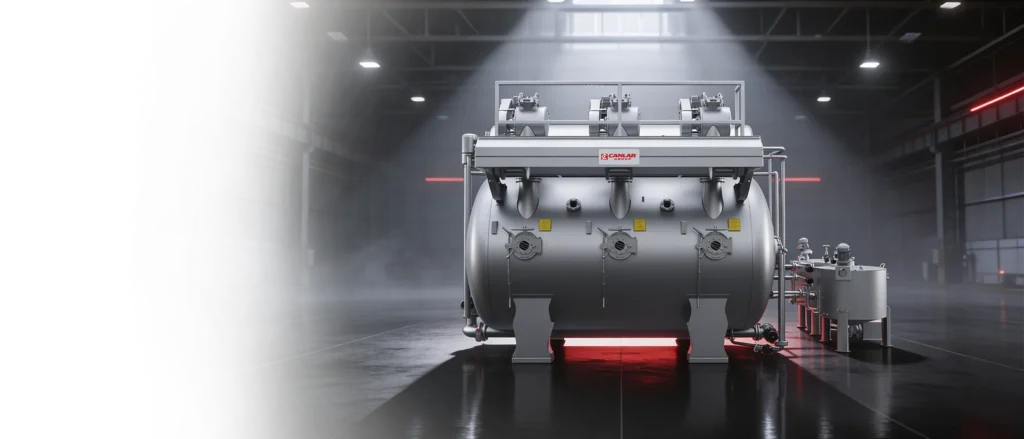
TECHsmart®
 FABRIC DYEING
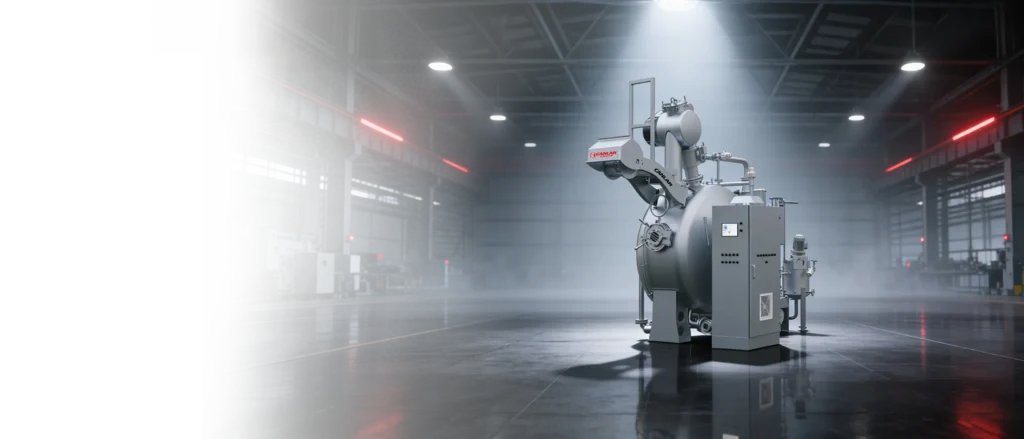
Mini TECHdye-Soft®
 FABRIC DYEING
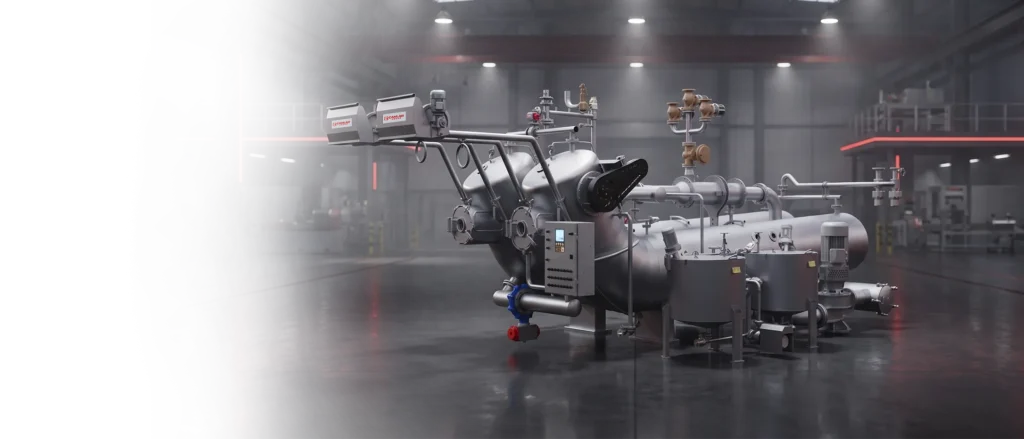
Active-soft Long Tube®
 FABRIC DYEING