


- Model
- Active-soft Long Tube®
- Type
- Long tube fabric dyeing
- Fabric weight
- 50 – 1200 g/m
- Capacity
- 150 – 1100 kg
Dyes fast,
without wearing the fabric.
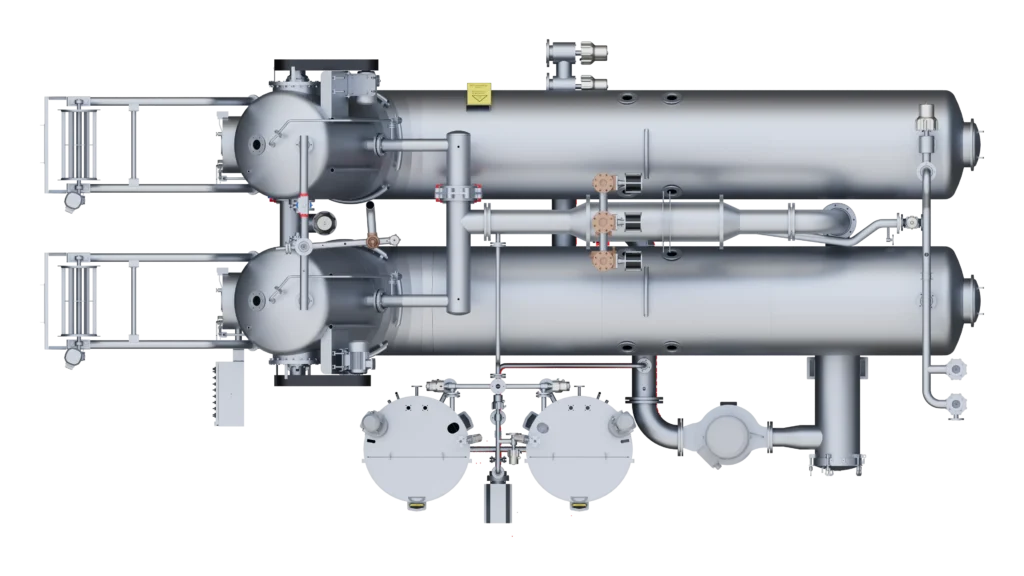
Active-soft Long Tube® was designed so that speed on delicate fabrics is never won at the expense of quality. Long tube geometry, tension-free circulation and a nozzle system that changes with the fabric type bring a wide range together in a single machine family, from fine knits to heavy wovens.
Raising the speed of a dyeing machine is easy; the hard part is protecting the fabric.
-
The handle is lost
Fabric that has been mechanically strained never returns to its former softness after dyeing.
-
Marks are permanent
Creases and marks formed in fabric that moves under tension cannot be corrected afterwards.
-
The shade drifts
An irregular flow rate turns into localized color variation within the same batch.
Six points that turn speed into quality
Speed on its own is not a value in a dyeing machine; what matters is how the fabric withstands that speed. The design of Active-soft Long Tube® is built on striking that balance.

-
01
Long tube geometry
The fabric moves along a wide arc inside a long, horizontal tube.
Your gain. The mechanical load on the fabric is spread along the path, so handle and surface are preserved even at high speed.
-
02
Tension-free circulation
The main circulation pump is inverter driven; the flow works in a regime that carries the fabric rather than pulling it.
Your gain. The fabric advances without being stretched, which reduces the risk of elongation and deformation in fine knits.
-
03
A nozzle that changes with the fabric
There are three nozzle types: H, M and G. The variable nozzle with two contact points is selected according to the fabric type.
Your gain. Fabrics from 50 g/m to 1200 g/m are run within the same machine family, each at a water speed suited to it.
-
04
Inverter-controlled reel
Reel speed reaches up to 600 m/min on the G type and 450 m/min on the H type, and is adjusted steplessly by inverter.
Your gain. The fabric passes through the bath more often, so dyestuff distributes more evenly and the process time shortens.
-
05
Teflon-coated fabric basket
The fabric basket is fully Teflon coated and has a special perforated structure; water on the fabric returns quickly to the pump.
Your gain. The fabric stacks neatly without touching metal, and the machine runs on less water.
-
06
Automatic dosing and measurement
A chemical tank with dosing pump, automatic analog dosing, water intake by flow meter and an end-detection sensor are standard.
Your gain. The recipe runs without manual intervention, and the machine knows where the batch begins and ends.
Three critical points
where the machine meets the fabric
Teflon-coated fabric basket
The fabric basket is fully Teflon coated; the fabric never touches a metal surface and stacks neatly inside the basket. The special perforated structure was designed to return the water on the fabric to the pump quickly.
The ability to run on less water, and movement that leaves no mark on the surface.

Three-stage Kalibo door
The door is reinforced with a support cylinder and can be opened and closed easily by one person. Three separate safety stages prevent it from opening under pressure.
Ergonomics for the operator, safety for the plant.

Double-sided bearing
The reel shaft is supported by long-life bearings on both sides. In a machine that runs continuously at high speed, the bearing is one of the parts that determines service life.
Vibration falls, maintenance intervals lengthen, and the speed is preserved over the years.

This investment is approved by more than one person
The same machine tells each person at the table something different. We answer each of their questions separately.
-
Business owner
More production from the same floor area
A shorter process raises the number of batches per shift. Because one machine family covers both light and heavy weights, the need for a second line is reduced.
- More batches per shift
- Wide fabric range
- Long service life
-
Dyehouse manager
A safe result on delicate fabric
Thanks to tension-free circulation and Teflon contact surfaces, the risk of marks and deformation falls on polyester, microfiber and fine knits.
- Tension-free dyeing
- Nozzle matched to fabric
- Automatic dosing
-
Purchasing
Supply without risk
Manufacture to pressure vessel standards, independent inspection, testing before dispatch and a single point of contact. There is no waiting in an import queue for spare parts.
- Certified manufacture
- Single point of responsibility
- Fast parts
It arrives on site ready to run
You are not testing a prototype. The machine is run before it leaves our factory.
-
01
Design and validation
Type, number of tubes and nozzle selection according to your fabric type, weight range and plant infrastructure, with design validation at our R&D center.
-
02
Manufacturing
Body, piping and control panel are produced in our own facility. Every part is finished at its own station.
-
03
Factory testing
The machine is fully assembled and passes hydrostatic pressure and function testing; the panel is verified by simulation.
-
04
Commissioning
Our field team carries out the installation and trains the operators. Remote support and periodic maintenance follow.
Sustainability is our priority
Speed, when it is built correctly, is a saving. Every process that is shortened means less steam, less electricity and more production within the same shift.
A process that does not strain the fabric protects not only quality but resources. Every batch that is not reprocessed is water and chemicals never spent.
-
A shorter process, less energy
High reel speed and fast bath circulation finish the same work in less time.
For your plantSteam and electricity costs fall, and the number of batches per shift rises.
For the planetEvery cubic meter of steam burned is a direct carbon emission; a shorter process shortens the emission with it.
-
Running on less water
The special perforated fabric basket returns the water on the fabric to the pump quickly, so less water is held in the system.
For your plantWater and heating load per bath are reduced.
For the planetLess water means less wastewater; the load reaching treatment shrinks at source.
-
Protecting the fabric means reducing waste
Tension-free circulation and Teflon contact surfaces reduce scrap caused by marks and deformation from the outset.
For your plantReprocessing and waste shrink as cost items.
For the planetEvery meter of fabric that is not scrapped is fiber, water and energy not spent.
-
Long-life materials
Every surface in contact with liquid is 316L stainless steel, and double-sided bearing extends the life of the machine.
For your plantMaintenance cost becomes predictable and reinvestment is deferred.
For the planetEvery machine that is not built is steel, energy and transport not spent.
The common denominator of the work at our R&D center is this: achieving the same color with fewer resources and fewer attempts. We assess every new solution we develop against that measure.
Two types, one machine family and technical data
| Item | Active-soft/G | Active-soft/H |
|---|---|---|
| Designed for | Delicate, low weight | Heavy weight |
| Fabric weight | 50 – 500 g/m | 200 – 1200 g/m |
| Reel speed | 600 m/min | 450 m/min |
| Nozzle | Variable nozzle, stable water speed | Variable type nozzle |
| Typical use | Woven and knitted, polyester and microfiber | Dyeing and bleaching |
| Capacity range | 150 – 600 kg | 200 – 1100 kg |
| Main circulation pump | Inverter controlled, tension-free dyeing |
|---|---|
| Reel | Inverter controlled |
| Nozzle types | H · M · G · two contact points |
| Fabric basket | Fully Teflon coated, special perforated structure |
| Door | Kalibo · 3 safety stages · with support cylinder |
| Bearing | Double sided, long life |
| Water intake | Flow meter controlled |
| Dosing | Chemical tank with dosing pump · automatic analog dosing |
| End detection | By sensor |
| Contact surfaces | 316L stainless steel |
| CM-01-01T · G type · 1 tube | 150 kg · 20 kW · 10,800 × 2,400 × 3,250 mm |
|---|---|
| CM-01-02T · G type · 2 tubes | 300 kg · 40 kW · 10,800 × 3,700 × 3,250 mm |
| CM-01-04T · G type · 4 tubes | 600 kg · 70 kW · 10,800 × 6,700 × 3,250 mm |
| CM-02-01T · H type · 1 tube | 200 – 250 kg · 19.2 kW · 6,600 × 2,200 × 3,300 mm |
| CM-02-01T · H type · 1 tube | 320 – 400 kg · 19.9 kW · 7,600 × 2,500 × 3,300 mm |
| CM-02-01T · H type · 1 tube | 440 – 550 kg · 19.9 kW · 9,600 × 2,700 × 3,300 mm |
| CM-04-02T · H type · 2 tubes | 640 – 800 kg · 36.9 kW · 7,600 × 3,700 × 3,300 mm |
| CM-04-02T · H type · 2 tubes | 880 – 1100 kg · 36.9 kW · 9,600 × 3,900 × 3,300 mm |
Dimensions are approximate and may be changed without notice according to the configuration. Exact dimensions for plant layout are shared at the quotation stage.
- TÜV approved
- AD 2000 Merkblatt
- EN 13445
- ASME
- CE · 2014/68/EU
- ISO 9001
- ISO 14001
- Ministry-approved R&D and Design Center
The most asked questions before investing
01 Should I choose the G type or the H type?
The choice is made according to the fabric weight you run. If you mainly dye delicate, low-weight fabrics in the 50–500 g/m range, the G type is suitable; if you work with heavy fabrics in the 200–1200 g/m range and also carry out bleaching, the H type is suitable. The weight ranges of the two types overlap in the 200–500 g/m band, and within that band the decision is made together, according to reel speed and your process priority.
02 Does high reel speed damage the fabric?
What damages the fabric is not the speed itself but the tension applied to the fabric at that speed. The long tube geometry spreads the load on the fabric along the path, the inverter-controlled pump carries the flow without pulling the fabric, and the Teflon-coated basket removes metal contact. When these three work together, speed is not won at the expense of quality.
03 Which fabric types is it suitable for?
Woven and knitted fabrics; cotton, synthetic and blended fibers. It gives particularly good results on polyester and microfiber fabrics. An H, M or G nozzle is selected according to the fabric type, and the nozzle selection keeps the water speed at a level the fabric can withstand.
04 How is the capacity determined?
Capacity is scaled by the number of tubes. On the G type, configurations with 1, 2 or 4 tubes give 150, 300 and 600 kg capacity; on the H type, configurations with 1 or 2 tubes range from 200 kg up to 1100 kg. We determine it together, based on your daily production target and your typical batch size.
05 How much space does it take in my plant?
Because this is a long tube design, machine length is the determining figure: approximately 10,800 mm on the G type, and between 6,600 and 9,600 mm on the H type. Width varies with the number of tubes, and the height is approximately 3,250–3,300 mm. The layout plan and connection points are shared at the quotation stage.
06 How do spare parts, training and the warranty work?
Because production from the body to the automation panel is carried out in our own facility, parts come from our own stock. During commissioning our field team provides operator training on site. The warranty period and scope are set by contract; after the warranty, remote connection, periodic maintenance and field service continue.
Tell us your fabric weight and your daily target,
and we will choose the right type together.
Share your fabric type, weight range, form and daily production target, and we will come back to you with a suitable type, number of tubes and nozzle recommendation.
Our Other Dyeing Solutions
 FABRIC DYEING
TECHsmart®
 FABRIC DYEING
Mini TECHdye-Soft®
 FABRIC DYEING
AIRsmart®
 FABRIC DYEING