


- Model
- TECHsmart®
- Type
- HT fabric dyeing
- Fabric form
- Open width · tubular
- Manufacturing standard
- AD 2000 · EN 13445 · ASME
What the recipe says on paper is what comes out of the vessel.
TECHsmart® is a system that does not leave dyeing to the operator's judgment. Every step, from the nozzle setting to the washing volume, is measured, recorded and repeated exactly in the next batch.
-

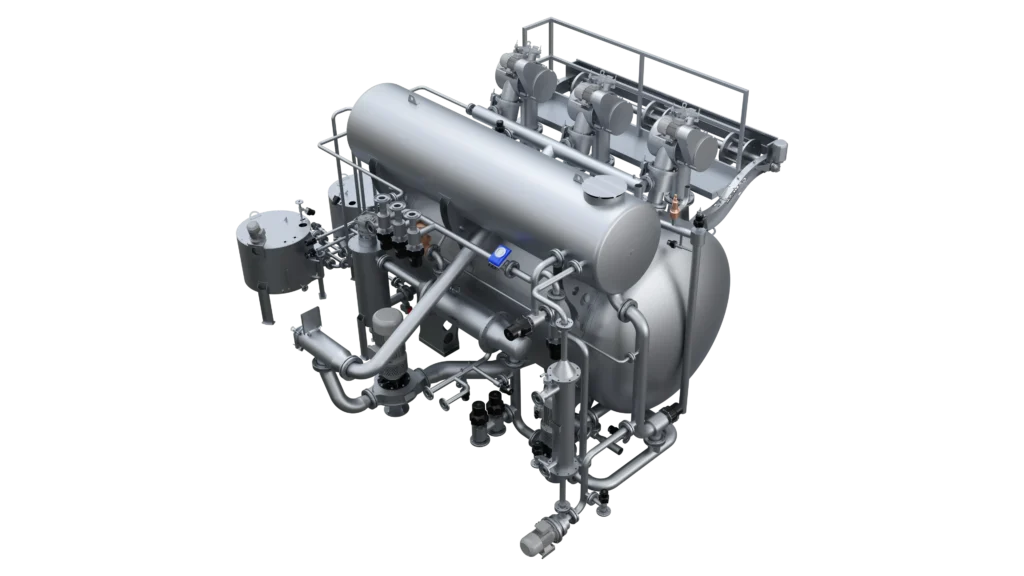
Fig. 1 — General view1:25 -

Fig. 2 — Side view1:25
The most expensive job in a dyehouse is the batch that has to be dyed twice.
-
The loss doubles
Twice the water, twice the chemicals, twice the steam — and machine time spent all over again.
-
The delivery date slips
A redyed batch pushes back the entire production plan behind it.
-
The fabric suffers
Every repeat takes something away from fiber strength and fabric handle.
Repeatability is won at six points
The outcome of dyeing is decided not by the vessel but by the points the liquor passes on each circuit. For every stop we have written down what happens and what you gain.
-
01
Adjustable nozzle
The nozzle gap is adjusted between 2 and 8 mm during the process; a pressure of 1.8–2 bar is reached in the fully closed position.
Your gain. Every fabric type, including full elastane, is dyed in open width without crease marks or shade variation.
-
02
Double direction circulation
The vertical pump provides the pressure at the nozzles; the horizontal pump keeps the bath homogeneous and handles heating, cooling and filtration.
Your gain. The liquor circulation cycle is completed in 20 seconds; no dead zones remain and the risk of shade deviation ends at source.
-
03
Combined heat exchanger and filter
Heat transfer and filtration are combined in a single body; the group is mounted clear of the floor.
Your gain. Idle liquor is reduced, heating and cooling times are shortened, and filter maintenance becomes simpler.
-
04
Liter-based washing
Washing steps are defined in kg/L; the water released is counted by the flowmeter and the step closes at that point.
Your gain. Every batch is washed with the same amount of water. The operator's “let it run a little longer” decision is taken out of the process.
-
05
Proportional dosing
Dyestuff and chemicals are added proportionally, according to time and the process curve.
Your gain. Fluctuation caused by sudden dosing ends; the recipe is repeated exactly.
-
06
Auto-synchro plaiter and Teflon J-Box
The plaiter runs in synchronization with the inner reel speed; the J-Box is Teflon-coated over its full length.
Your gain. The fabric never touches metal and stacks evenly. Glazing on woven fabric is eliminated.
Three design decisions that make the difference
Combined heat exchanger and filter group
A separate heat exchanger and a separate filter mean two extra volumes, two extra leak points and liquor collecting at the bottom. These two functions were combined in a single body and the group was raised clear of the floor.
The liquor held in the system was reduced, the water in the bath heats up faster, and the filter is reached through a single cover.

Self-cleaning filter
The reducer-driven filter cleans itself while the process is running. Pressure loss from fiber build-up and cleaning stops are removed from the schedule.
No operator intervention is required with linting fabrics or long batches.

Dosing and washing line
Chemicals are added proportionally along the process curve; in washing, the water released is counted liter by liter and the step closes by itself once the target is reached.
There are no moving parts in the measurement: a line that does not wear, does not drift, and reads the same value years later.

This investment is approved by more than one person
The same machine tells each person at the table something different. We answer each of their questions separately.
-
Business owner
Return on the investment
Water, steam and chemical costs per batch fall, and losses caused by redyeing are reduced. The machine keeps its second-hand value for decades.
- Measurable consumption
- Long service life
- Local service
-
Dyehouse manager
A result independent of the shift
The recipe is written into the automation and operator discretion is removed. Off-shade results and reprocessing become less frequent.
- Repeatable recipe
- Traceable process
- Easy maintenance
-
Purchasing
Supply without risk
Manufacturing to pressure vessel standards, third-party inspection, testing before shipment and a single point of contact. No waiting in an import queue for spare parts.
- Certified manufacturing
- Single responsibility
- Fast parts
It arrives on site ready to run
You are not testing a prototype. The machine is run before it leaves our factory.
-
01
Design and validation
Configuration according to your fabric type, capacity and plant infrastructure; design validation at our R&D center.
-
02
Manufacturing
The vessel, pipework and control panel are produced in our own facility. Every part is finished at its own station.
-
03
Testing at the factory
The machine is fully assembled and passes hydrostatic pressure and functional tests; the control panel is verified by simulation.
-
04
Commissioning
Our field team installs the machine and trains the operators. Remote support and scheduled maintenance follow.
Our priority is sustainability
Textile finishing is one of the most water- and energy-intensive branches of industry. Instead of turning that fact into a marketing headline, we made it a design principle: water not spent in a batch is water that never has to be recovered.
The greenest batch is the one that is not dyed a second time. Every repeated dyeing means twice the water, twice the chemicals, twice the energy.
-
Water is measured, not estimated
Washing steps are defined by volume; every batch is finished with the same amount of water.
For your plantWater, heating and treatment costs become predictable.
For the planetWater that is not used is water that never reaches the treatment plant; it stays in the basin.
-
No more chemicals than needed
Salt and chemicals are added only as the process requires, and residues are monitored throughout washing.
For your plantChemical costs and the need for reprocessing are reduced.
For the planetSalt and dyestuff are among the hardest pollutants to treat in wastewater. Reducing them at source is the most effective method.
-
Shorter heating, less steam
A high heat-transfer exchanger and a shorter process time reduce energy consumption together.
For your plantSteam and electricity costs fall, and more batches leave the same shift.
For the planetEvery cubic meter of steam burned is a direct carbon emission; a shorter process shortens the emission as well.
-
The most sustainable machine is the one you do not replace
A stainless steel body and robot welding keep the machine performing the same way for decades.
For your plantReinvestment is postponed and second-hand value is preserved.
For the planetEvery machine that is not built means steel, energy and transport that are not spent.
The common denominator of the work at our R&D center is this: achieving the same color with fewer resources and fewer attempts. We assess every new solution we develop against that measure.
Technical data and comparison
| Item | Conventional machine | TECHsmart® |
|---|---|---|
| Liquor ratio | High — large vessel volume | Low — combined group and elevated mounting |
| Nozzle | Fixed geometry | Adjustable between 2–8 mm, 1.8–2 bar |
| Circulation | Single direction | Vertical + horizontal, 20 s cycle |
| Washing | By time | By volume, flowmeter controlled |
| Salt control | Trust in the recipe | Instant, by conductivity measurement |
| Fabric contact | Metal surface | Full-length Teflon, electropolished |
| Adjustable nozzle range | 2 – 8 mm |
|---|---|
| Nozzle pressure | 1.8 – 2 bar |
| Liquor circulation cycle time | 20 s |
| Fabric form | Open width |
| Circulation | Vertical + horizontal, independent pumps |
| J-Box | Teflon-coated over full length, two pieces |
| Lid safety | 4 mechanical stages + pressure transmitter |
| Lighter than 300 g/linear m | Ø 90 mm |
|---|---|
| 300 – 400 g/linear m | Ø 110 mm |
| 400 – 600 g/linear m | Ø 140 mm |
| 600 – 800 g/linear m | Ø 168 mm |
| Heavier than 800 g/linear m | Ø 220 mm |
At the stated fabric weights, maximum fabric speed is reached with the corresponding nozzle diameter. Capacity, vessel volume and operating temperature figures are shared on request.
- TÜV certified
- AD 2000 Merkblatt
- EN 13445
- ASME
- CE · 2014/68/EU
- ISO 9001
- Ministry-approved R&D and Design Center
The questions asked most before the investment
01 Which fabric types and weights is it suitable for?
Knitted and woven fabrics made of cotton, synthetic and blended fibers, in open width and tubular form. The nozzle diameter is selected according to fabric weight; thanks to the adjustable nozzle, fabrics made entirely of elastane are also dyed without leaving crease marks.
02 How long does commissioning take?
Because the machine is fully assembled and tested at our factory, the time spent on site is short. The exact duration is determined by your plant infrastructure and the number of machines, and is shared together with a schedule at the quotation stage.
03 How does spare part supply work?
Because everything from the vessel to the automation panel is produced in our own facility, parts come from our own stock. There is no waiting in an import queue, and because part records are kept per machine, the correct part can be identified years later.
04 Will it integrate with my existing dyehouse?
Your steam, water and electricity infrastructure is measured and the configuration is set accordingly. On the automation side, connection options are offered for recipe transfer and reporting with your existing systems.
05 Is operator training provided?
Our field team trains the operators on site during commissioning. Remote support and a scheduled maintenance plan follow.
06 What do the warranty and after-sales support cover?
The warranty period and scope are defined in the contract. Remote connection, scheduled maintenance and field service continue after the warranty period as well.
Tell us about your fabric, and we will build the process together.
Share your fabric type, weight, width and daily capacity, and we will come back to you with a suitable configuration proposal.