


- Model
- TECHyarn-Soft®
- Type
- Package and fiber dyeing
- Liquor ratio
- 1:6 – 1:7
- Operating temperature
- 140 °C
The inside and the outside of the package
come out the same color.
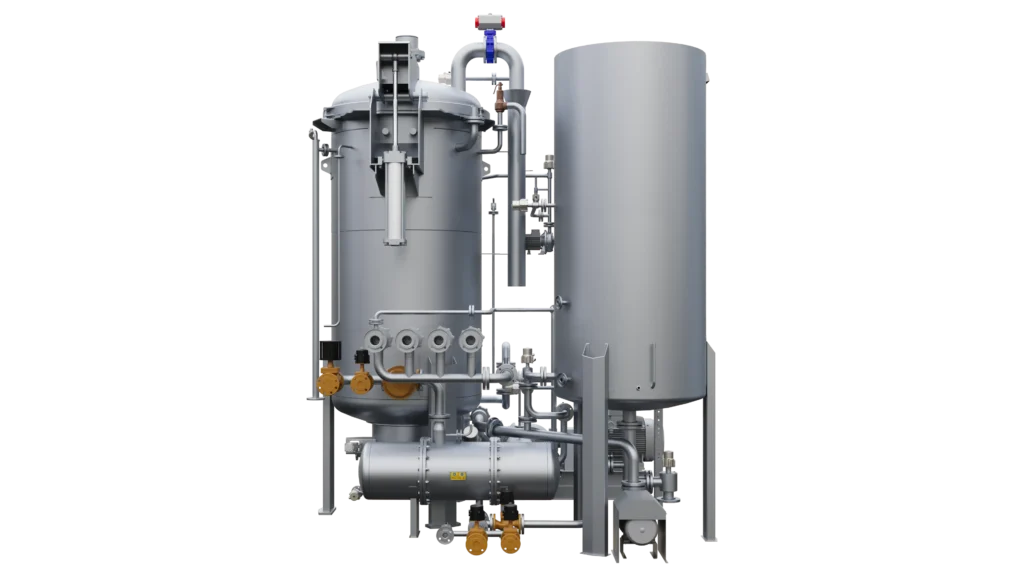
TECHyarn-Soft® is a low-liquor universal dyeing machine with a vertical vessel construction. The liquor passes through the packages in both directions, and the flow is reversed automatically from inside to outside and from outside to inside at set intervals. Package, loose fiber, tops, hank, muff and vertical beam forms are all run on the same machine.


In package dyeing the color is not decided on the surface, but inside the winding.
-
Inside and outside
If the liquor loses speed as it passes through the winding, the inside of the package is dyed differently from the outside.
-
Winding density
A tightly wound package offers more resistance to the flow, and the same recipe gives a different result.
-
Partial loading
When the vessel is not filled completely the liquor ratio is disturbed, and a lot of water is heated for a little yarn.
Six points that reach every layer of the winding
In package dyeing the yarn does not move; the liquor does. Quality depends on how the liquor passes through the winding. The design of TECHyarn-Soft® makes that passage both bidirectional and measurable.
-
01
Bidirectional liquor flow
All packages are processed fully immersed in the liquor. To ensure penetration, the liquor passes through the packages in both directions.
Your gain. The inner and outer layers of the winding meet the same quantity of dyestuff.
-
02
Automatic flow reversal
The flow direction is reversed automatically from inside to outside and from outside to inside within set intervals. The reversal is carried out by the inside-outside flap system.
Your gain. Dyeing is carried out without any inside-outside difference in the packages, and no operator intervention is required.
-
03
Differential-pressure-controlled circulation
The main pump circulation is managed by differential pressure control, and the pump is inverter controlled.
Your gain. Even if the winding density changes from batch to batch, the force with which the liquor passes stays the same.
-
04
Partial loading at a constant liquor ratio
Thanks to the proportional level control system, the machine can be run at 100%, 75% and 50% loading capacities at a constant liquor ratio.
Your gain. A full vessel of water is not heated for half-batch work, and small orders become profitable.
-
05
Separate filling and draining lines
The filling and draining functions run on separate lines, so fresh liquor and bath liquor never mix.
Your gain. Rinsing is genuinely carried out with fresh water, and contaminated water does not return to the bath.
-
06
Air padding and safety
Air padding is created by compressed air from the top of the main vessel. The automatic carrier pressing system holds the carrier in place; a three-stage safety system and an automatic lid prevent the lid from being opened before the pressure has been fully released.
Your gain. The circulation pump works more efficiently, the carrier does not shift during the process, and the lid opens only when it is safe.
Three mechanisms that determine the result
Inside-outside flap system
The flap system reverses the direction of the liquor from inside to outside and from outside to inside without loss. The reversal takes place automatically at set intervals.
This is the main mechanism that allows dyeing without any inside-outside difference in the packages.

Automatic carrier pressing
The air-driven system applies pressure to the carrier once the lid has been closed, preventing it from moving during the process.
When the carrier does not shift, the flow path does not change, and the result repeats from batch to batch.

Interchangeable carriers
The carriers are designed according to the material form: package, loose fiber, tops, hank, muff and vertical beam. Different forms are run with the same machine body.
For a new material form, a new carrier is enough instead of a second machine.

This investment is approved by more than one person
The same machine tells each person at the table something different. We answer each of their questions separately.
-
Business owner
Small batches become profitable too
Thanks to the proportional level control, the machine runs at a constant liquor ratio at 75% and 50% loading capacities as well. A half-batch order is not dyed at the cost of a full vessel.
- Partial loading
- Short process time
- Long service life
-
Dyehouse manager
The inside-outside difference stops being a problem
Bidirectional flow and automatic reversal deliver an equal amount of dyestuff to every layer of the winding. Even if the winding density changes, the differential pressure control keeps the flow constant.
- Bidirectional flow
- Differential pressure control
- Rinsing with fresh water
-
Purchasing
Supply without risk
Manufacture to pressure vessel standards, independent inspection, testing before dispatch and a single point of contact. There is no waiting in an import queue for spare parts.
- Certified manufacture
- Single point of responsibility
- Fast parts
It arrives on site ready to run
You are not testing a prototype. The machine is run before it leaves our factory.
-
01
Design and validation
The vessel capacity and the carrier type are determined according to your material form, your batch size and your plant infrastructure, and design validation is carried out at our R&D center.
-
02
Manufacturing
Vessel, carrier, piping and control panel are produced in our own facility. Every part is finished at its own station.
-
03
Factory testing
The machine is fully assembled and passes hydrostatic pressure and function testing; the panel is verified by simulation.
-
04
Commissioning
Our field team carries out the installation and trains the operators. Remote support and periodic maintenance follow.
Sustainability is our priority
Two things determine consumption in yarn dyeing: the liquor ratio, and how full the vessel is running. TECHyarn-Soft® brings both under control; the liquor ratio holds even at half load.
Heating a lot of water for a little yarn is the quietest loss in a dyehouse. Maintaining the liquor ratio at partial loading removes that loss outright.
-
Partial loading at a constant liquor ratio
Proportional level control makes it possible to work at the same liquor ratio at 100%, 75% and 50% loading.
For your plantOn small batches, water, steam and chemical costs stay proportional to the batch size.
For the planetWater that is not heated unnecessarily means steam not burned and effluent not treated.
-
Low liquor ratio
The machine works at liquor ratios of 1:6 – 1:7 depending on the package density.
For your plantWater and heating load per bath are reduced.
For the planetLess water means less wastewater; the load reaching treatment shrinks at source.
-
Fresh water really stays fresh
Because filling and draining run on separate lines, fresh liquor and contaminated bath liquor do not mix.
For your plantThe rinsing step reaches its target with less water.
For the planetNot re-polluting water that is still clean reduces the treatment load from the outset.
-
Measured consumption
Process water is measured by electromagnetic flow meter and consumption is monitored on screen.
For your plantConsumption is not estimated but reported, and the place to improve becomes visible.
For the planetConsumption that is not measured cannot be reduced; measurement is the first step of sustainability.
The common denominator of the work at our R&D center is this: achieving the same color with fewer resources and fewer attempts. We assess every new solution we develop against that measure.
Example processes and technical data
| Item | Light shade (beige) | Dark shade (navy) |
|---|---|---|
| Batch quantity | 80 kg | 86 kg |
| Water consumption | 12 L/kg | 52 L/kg |
| Steam consumption | 0.73 kg/kg | 2.4 kg/kg |
| Electricity consumption | 0.10 kWh/kg | 0.18 kWh/kg |
| Package weight | 1.4 kg | 1.4 kg |
| Winding height | 150 mm | 150 mm |
| Vessel construction | Vertical type |
|---|---|
| Material forms | Package, loose fiber, tops, hank, muff, vertical beam |
| Fiber types | Cotton, polyester, polyester-cotton, acrylic, nylon, wool |
| Processes | Bleaching, dyeing, washing |
| Liquor ratio | 1:6 – 1:7 according to package density |
| Maximum operating temperature | 140 °C |
| Maximum operating pressure | 5 bar |
| Heating gradient | 4 – 5 °C |
| Cooling gradient | 2.5 – 3 °C |
| Liquor flow | Bidirectional · automatic inside-to-outside and outside-to-inside cycle |
| Circulation pump | Inverter controlled · differential pressure controlled |
| Pressurization | Air padding from the top of the vessel |
| Partial loading | 100% · 75% · 50% with proportional level control |
| Filling and draining | Separate lines · fast filling and draining by the main pump |
| HT drain | Standard |
| Safety | Three-stage safety system · pneumatic loading lid · quick lock |
| Lid | Automatic lid system that opens only after the pressure has been fully released |
| Measurement | Consumption monitoring by electromagnetic flow meter |
| Contact surfaces | W.Nr 1.4404 grade stainless steel |
| Coupled operation | Able to run coupled at 100% efficiency |
| Package carrier | Yarn in package form |
|---|---|
| Fiber carrier | Loose fiber and loose stock |
| Tops carrier | Tops form |
| Hank carrier | Hank (skein) form |
| Muff carrier | Muff form |
| Vertical beam carrier | Vertical beam form |
The carriers are designed according to the material form and are interchangeable. The example process values belong to the stated material, shade and recipe; actual consumption varies with the process. The manufacturer reserves the right to change manufacturing dimensions and technical information without notice.
- TÜV approved
- AD 2000 Merkblatt
- EN 13445
- ASME
- CE · 2014/68/EU
- ISO 9001
- ISO 14001
- Ministry-approved R&D and Design Center
The most asked questions about package dyeing
01 How is the color difference between the inside and the outside of the package prevented?
The liquor passes through the packages in both directions, and the flow is reversed automatically from inside to outside and from outside to inside at set intervals. The reversal is carried out by the inside-outside flap system, so the inner and outer layers of the winding meet the same quantity of dyestuff. The main pump circulation is also managed by differential pressure control, so even if the winding density changes from batch to batch, the force of the flow stays constant.
02 Can I dye a half batch?
Yes. Thanks to the proportional level control system, the machine can be run at a constant liquor ratio at 100%, 75% and 50% loading capacities. This is an important cost item in yarn dyeing: when a vessel runs half full the liquor ratio is normally disturbed and a lot of water is heated for a little yarn. Because the ratio is maintained on this machine, small orders are also dyed profitably.
03 Which material forms can it run?
Package, loose fiber, tops, hank, muff and vertical beam forms. The carriers are designed for these forms and are interchangeable; for a new form, a new carrier is enough instead of a second machine. Bleaching, dyeing and washing are carried out on fibers such as cotton, polyester, polyester-cotton, acrylic, nylon and wool.
04 How much water and energy does it consume?
Consumption depends largely on the depth of the shade. The two example processes in our catalog show that difference: on 20 denier polyester, a light shade run uses 12 L/kg of water and 0.73 kg/kg of steam, while a dark shade run uses 52 L/kg of water and 2.4 kg/kg of steam. If you share your own recipes, we will carry out the assessment together on those processes.
05 Does dirty water mix into the bath during rinsing?
No. The filling and draining functions run on separate lines, so fresh liquor and bath liquor never mix. Rinsing is therefore genuinely carried out with fresh water and reaches its target with less of it.
06 How do spare parts, training and the warranty work?
Because production from the body to the automation panel is carried out in our own facility, parts come from our own stock. During commissioning our field team provides operator training on site. The warranty period and scope are set by contract; after the warranty, remote connection, periodic maintenance and field service continue.
Tell us your material form and your batch size, and we will choose the right capacity together.
Share your yarn type, material form, typical batch size and daily production target, and we will come back to you with a suitable vessel capacity and carrier recommendation.