


- Model
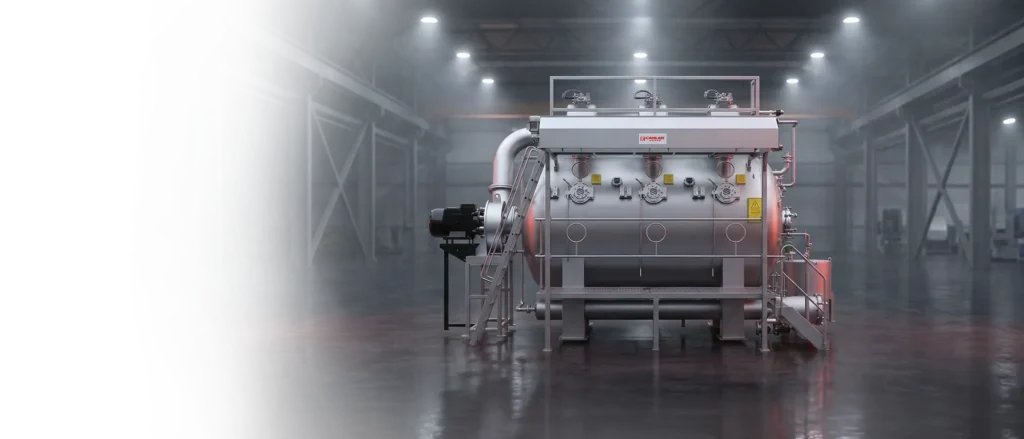
- Mini TECHdye-Soft®
- Type
- Sample and small-batch dyeing
- Fabric form
- Open width · tubular
- Capacity
- 10 – 100 kg
Color is born in the sample, and repeats in production.
Mini TECHdye-Soft® is designed for sample dyeing and low-weight production runs. It brings the process logic of our production machines into a small vessel: a recipe approved in the laboratory produces no surprises once it reaches the floor.
-

--- Capacity10-15 kg --- -

--- Capacity25 kg --- -

--- Capacity50 kg --- -

--- Capacity100 kg ---
The gap between sample and production is the least visible line in your cost sheet.
-
The schedule slips
Every sample that fails means another trial, and the collection delivery moves back with it.
-
Trust erodes
If the approved color shifts at shipment, there is no telling where the next order will go.
-
Resources are wasted
A small vessel looks inexpensive to run, but the trials are many; the total is what grows.
Six points that connect the sample to production
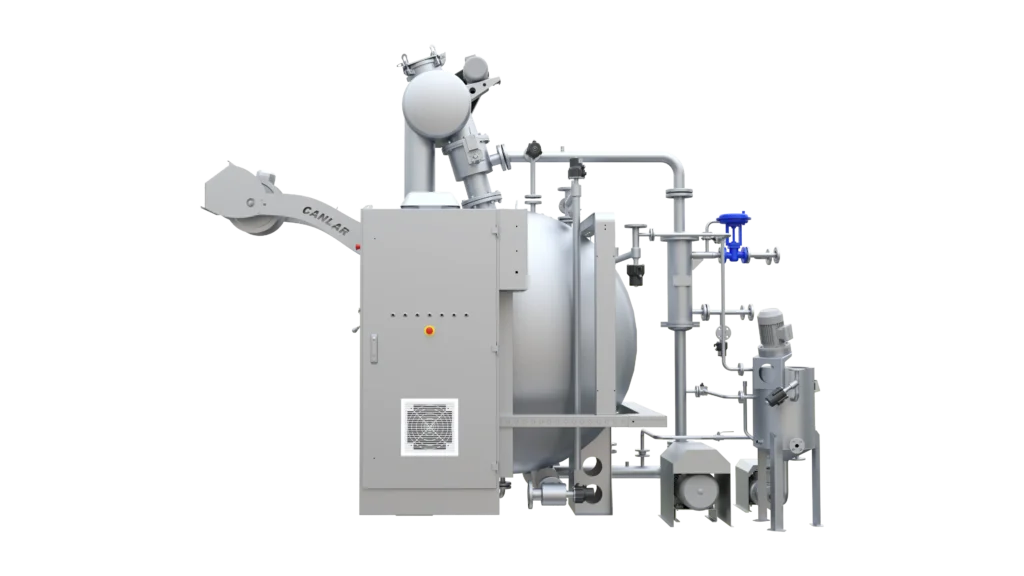
The job of a sample machine is not to find a color, but to carry the color it finds into production. The design of Mini TECHdye-Soft® is built around that transfer.
-
01
Low liquor ratio
The machine works at a liquor ratio between 1:8 and 1:10.
Your gain. The sample bath stays close to production conditions, so chemical ratios are not recalculated from scratch when the recipe is scaled up.
-
02
Adjustable inner drum speed
The inner drum speed is changed during the process.
Your gain. From fine knits to heavy wovens, different fabric groups are trialed on the same machine without straining the fabric.
-
03
Inverter-controlled circulation
The main circulation pump is inverter driven; flow is adjusted steplessly.
Your gain. The same recipe repeats across different fabric weights; the pump never runs harder than it needs to, so no energy is wasted.
-
04
135 °C operating temperature
The machine operates up to 135 °C.
Your gain. High-temperature processes for polyester and blends are trialed exactly as they will run, so no separate verification is needed in production.
-
05
Nozzle matched to capacity
A fixed nozzle is used at 10–20 kg capacities, a movable nozzle from 25 kg upwards.
Your gain. Nozzle behavior matched to sample size: gentle on the fabric in small batches, close to production behavior in larger ones.
-
06
Stainless contact surfaces
Every surface in contact with the process bath is W.Nr 1.4571 stainless steel.
Your gain. Color carry-over and corrosion staining are eliminated; the machine gives the same result years later.
Three design decisions
that connect the sample room to production
The same process, at small scale
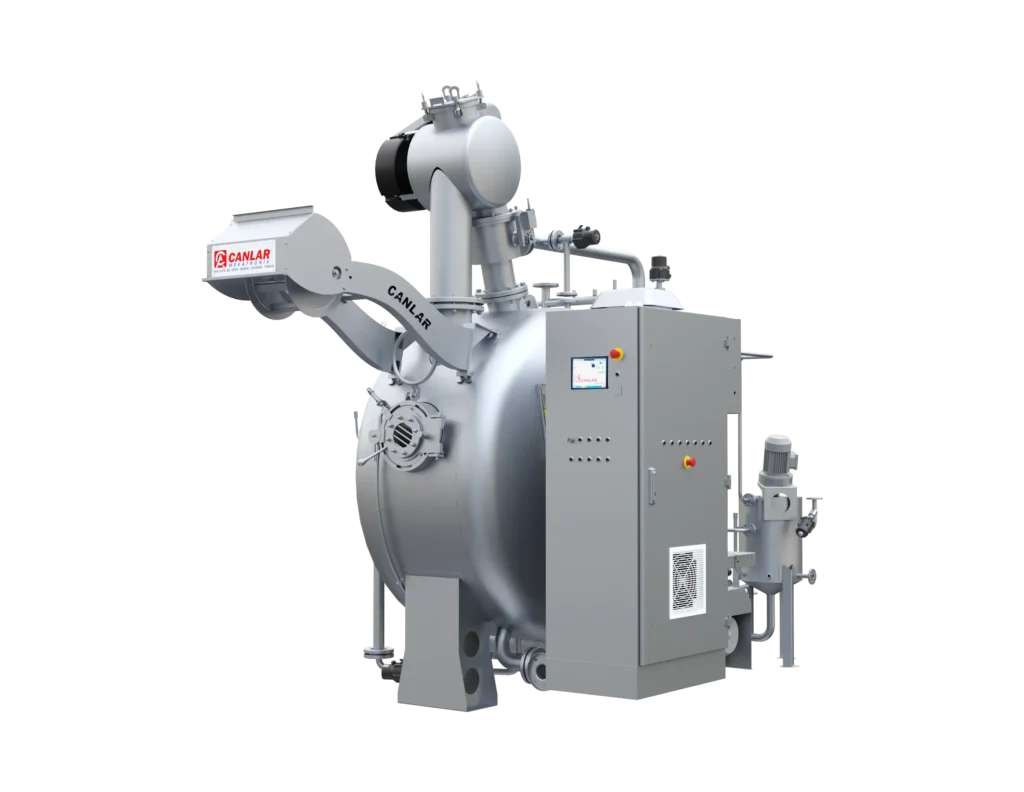
When a sample machine behaves differently from a production machine, every approved recipe turns into a guess. Mini TECHdye-Soft® was designed within the same framework as our production machines in terms of liquor ratio, temperature range and contact surfaces.
A color that holds in the laboratory is not searched for again once it reaches the vessel.
Different fabric groups on one machine
Inner drum speed and circulation flow are adjusted independently of each other. You can move from fine knit to heavy woven within the same day, and both tubular and open-width forms are run.
The need for a second machine in the sample room is reduced.

From ten kilos to a hundred
There are four capacity steps: 10–20, 20–30, 50–60 and 80–100 kg. The smallest step is chosen for the sample room, the upper steps for boutique collections and short-run production.
The same machine family, the same automation logic, the same spare part channel.

This investment is approved by more than one person
The same machine tells each person at the table something different. We answer each of their questions separately.
-
Business owner
The production vessel returns to its real job
Sample and short-run work is separated from the production machine. The large vessel works on the planned order while the sample room moves at its own pace.
- Capacity freed up
- Short runs become profitable
- Long service life
-
Dyehouse manager
A recipe that transfers to production
A recipe built on the sample machine is scaled up with the same process logic. Color-searching rounds and reprocessing become less frequent.
- Transferable recipe
- Adjustable process
- Easy cleaning
-
Purchasing
Same roof, same standard
The sample machine is built in the same facility and to the same manufacturing standards as our production machines. One point of contact, one spare part channel.
- Certified manufacture
- Single point of responsibility
- Fast parts
It arrives on site ready to run
You are not testing a prototype. The machine is run before it leaves our factory.
-
01
Design and validation
Configuration according to your fabric type, sample volume and plant infrastructure, with design validation at our R&D center.
-
02
Manufacturing
Body, piping and control panel are produced in our own facility. Every part is finished at its own station.
-
03
Factory testing
The machine is fully assembled and passes hydrostatic pressure and function testing; the panel is verified by simulation.
-
04
Commissioning
Our field team carries out the installation and trains the operators. Remote support and periodic maintenance follow.
Sustainability is our priority
The sample room is where a dyehouse repeats itself most often. A correct sample means water and chemicals that are never spent in production; this is the least expensive place to save.
The greenest batch is the one that starts with the right sample. Every problem left unsolved at sample scale grows many times over in production.
-
Small vessel, small loss
Trials and color development are carried out in a 10–100 kg vessel instead of the production vessel.
For your plantWater, steam and chemical cost per trial falls.
For the planetRunning the same trial in a large vessel consumes many times the resources; small scale consumes less from the outset.
-
Low liquor ratio
The machine works at a liquor ratio of 1:8 – 1:10.
For your plantWater and heating load per bath are reduced.
For the planetLess water means less wastewater; the load reaching treatment shrinks at source.
-
A correct sample, production without repeats
A recipe that transfers to production reduces the need for a second dyeing from the start.
For your plantReprocessing and waste shrink as cost items.
For the planetA second dyeing that is never carried out is water, chemicals and energy never spent.
-
Long-life materials
Contact surfaces are W.Nr 1.4571 stainless steel; body, piping and control panel are produced in our own facility.
For your plantMaintenance cost becomes predictable and reinvestment is deferred.
For the planetEvery machine that is not built is steel, energy and transport not spent.
The common denominator of the work at our R&D center is this: achieving the same color with fewer resources and fewer attempts. We assess every new solution we develop against that measure.
Technical data and comparison
| Item | Conventional sample machine | Mini TECHdye-Soft® |
|---|---|---|
| Liquor ratio | High | 1:8 – 1:10 |
| Inner drum speed | Fixed | Adjustable |
| Circulation pump | Fixed speed | Inverter controlled, stepless |
| Operating temperature | Limited | Up to 135 °C |
| Nozzle | Single type | Fixed or movable, according to capacity |
| Contact surfaces | Standard stainless | W.Nr 1.4571 |
| Liquor ratio | 1:8 – 1:10 |
|---|---|
| Operating temperature | Up to 135 °C |
| Fabric form | Open width · tubular |
| Fabric type | Cotton, synthetic and blends; woven and knitted |
| Processes | Bleaching, dyeing, washing |
| Inner drum | Adjustable speed |
| Main circulation pump | Inverter controlled |
| Contact surfaces | W.Nr 1.4571 stainless steel |
| Nozzle | Fixed at 10–20 kg · movable from 25 kg upwards |
| 10 – 20 kg | 3000 × 2000 × 2600 mm · 5.5 kW |
|---|---|
| 20 – 30 kg | 3000 × 2000 × 2600 mm · 9 kW |
| 50 – 60 kg | 3900 × 2500 × 3300 mm · 9 kW |
| 80 – 100 kg | 3900 × 2500 × 3300 mm · 13 kW |
Dimensions are approximate and may vary with the configuration. Exact dimensions for plant layout are shared at the quotation stage.
- TÜV approved
- AD 2000 Merkblatt
- EN 13445
- ASME
- CE · 2014/68/EU
- ISO 9001
- ISO 14001
- Ministry-approved R&D and Design Center
Choosing a sample machine: the most asked questions
01 Will the result I get on the sample machine be the same on the production machine?
Mini TECHdye-Soft® was designed with the same liquor range, the same temperature range and the same contact surface material as our production machines. These three are the main factors that determine the color result; when they are kept the same, the recipe is not searched for again as the scale grows. As long as the fabric, the dye group and the water quality do not change, the results match.
02 Which capacity should I choose?
There are four steps: 10–20, 20–30, 50–60 and 80–100 kg. For color development and sampling only, the smallest step is sufficient. If boutique collections, short-run orders or small-meterage production are also planned, the upper steps are preferred. Share your daily number of samples and your typical batch size and we will determine it together.
03 Which fabric types is it suitable for?
Tubular and open-width forms; woven and knitted fabrics made of cotton, synthetic and blended fibers. Bleaching, dyeing and washing processes are carried out on the same machine. Thanks to the 135 °C operating temperature, high-temperature processes for polyester and blends can also be applied.
04 Will it fit into my existing sample room?
The smallest step requires an area of approximately 3000 × 2000 mm and a height of 2600 mm. Your steam, water and electricity infrastructure is measured and a layout plan is prepared; exact dimensions and connection points are shared at the quotation stage.
05 How do spare parts and service work?
Because production from the body to the automation panel is carried out in our own facility, parts come from our own stock. There is no waiting in an import queue, and a parts record is kept for each machine, so the correct part can be identified years later.
06 What do operator training and the warranty cover?
During commissioning our field team provides operator training on site. The warranty period and scope are set by contract; after the warranty, remote connection, periodic maintenance and field service continue.
Tell us your fabric and your sample volume,
and we will choose the right capacity together.
Share your fabric type, weight, form and daily number of samples, and we will come back to you with a suitable capacity and configuration.
Our Other Dyeing Solutions
 FABRIC DYEING
TECHsmart®
 FABRIC DYEING
Active-Soft Long Tube®
 FABRIC DYEING
AIRsmart®
 FABRIC DYEING